
250 Years Later – Learning More About the Declaration of Independence
Dateline: Jul. 4, 2026
250 Years Later – Learning More About the Declaration of Independence Dateline: Jul. 4, 2026
Tip: For a full size imageRight click on it (cell phone: press and hold it), and select Open Image in New Tab.
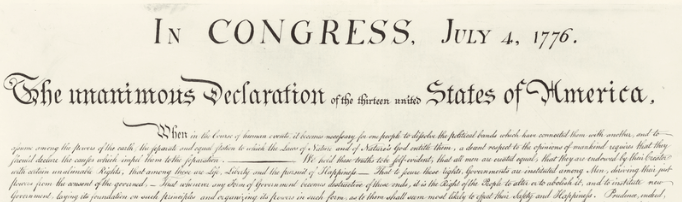
Town Hall Having just experienced the 250th anniversary of the signing of the Declaration of Independence, it behooves us to reacquaint ourselves with this foundational document. You can find the complete text in the U.S. National Archives. Declaration of Independence: a Transcript For those who can still read cursive writing, a copperplate engraving of the aging original was commissioned in 1823 by Secretary of State John Quincy Adams to preserve the document. It was produced by printer William Stone. Once such copy is on display in the meeting room of the old Town Hall. William Stone 1823 engraving (82 MB) Of significance is the origin of the Declaration. Richard Henry Lee of Virginia introduced a resolution on June 7, 1776 in the Continental Congress meeting in Philadelphia to proclaim that the colonies were now independent. As a member of the Congress, Thomas Jeffersion was appointed to write the "original rough draught" in June 1776. To examine the original handwritten text and see the edits that were made, you can go to the following site. This site features a magnifier for examining all the edits. Jefferson's "original rough draught" For example, the original draft stated this. "We hold these truths to be sacred & undeniable; that all men are created equal & independant, that from that equal creation they derive rights inherent & inalienable, among which are the preservation of life, & liberty, & the pursuit of happiness; that to secure these ends, governments are instituted among men, deriving their just powers from the consent of the governed;" When he showed the draft to John Adams and Benjamin Franklin, they made minor edits (shown in bold). "We hold these truths to be self-evident; that all men are created equal & independant, that from that equal creation they derive rights inherent & inalienable, among which are the preservation of life, & liberty, & the pursuit of happiness; that to secure these ends, governments are instituted among men, deriving their just powers from the consent of the governed;" A key change was Franklin's replacement of "sacred & undeniable" with "self-evident." Sacred implied a belief in God or Providence while self-evident implied something that was obvious to a wider audience. The final version of the Declaration was hammered out by the Congress and finally approved on July 4th and contained the following final words. It was set to type and printed as a "broadside" by Philadelphia printer John Dunlap. "We hold these Truths to be self-evident, that all Men are created equal, that they are endowed by their Creator with certain unalienable Rights, that among these are Life, Liberty, and the Pursuit of Happiness–That to secure these Rights, Governments are instituted among Men, deriving their just Powers from the Consent of the Governed," A significant change proclaimed that our rights come from the Creator, not from government. In all versions, a decisive phrase stands out: governments get their just power from the consent of the people. Government does not take power away from the people without their consent, nor does it consist of a hereditary nobility lording it over the common folks. That's a big problem we still need to solve: bloated govenment, the Nanny State, and the Deep State. President Ronald Reagan once issued the most feared nine words in government: "I'm from the government and I'm here to help." An interactive facsimile document can be viewed at the Princeton University Library web site. Princeton University interactive copy This web site offers a viewer with which you can magnify and move about the document. Notice the instances where an "f" was used instead of an "s." The Declaration was sent to Philadelphia printer John Dunlap and printed as a "broadside" and later became known as the Dunlap Broadside. Copies were sent to state assemblies, conventions, and commanding officers of the Continental troops. One special copy was delivered to Guess Who? What You Can DoTake a few minutes and read the Declaration of Independence. Don't let someone else tell you what is says. Read it for yourself. |